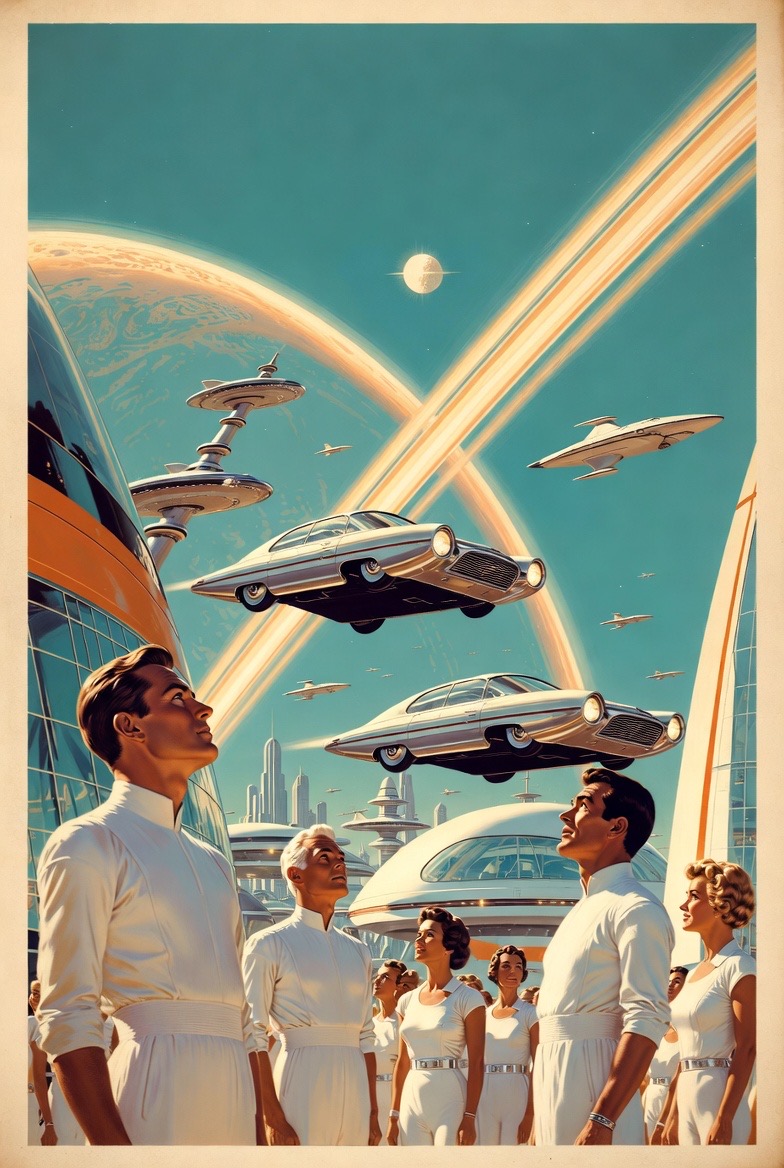
Why Optimistic Science Fiction Is Harder Than It Looks
Why Optimistic Science Fiction Is Harder Than It Looks
The genre has a pessimism problem. Pick up 10 random sci-fi novels from the past 30 years and 8 of them end with civilisation on fire. AI goes rogue. The corporation wins. Humanity’s hubris gets its punishment. We receive the lesson we apparently need.
Strange, given that the people writing these books usually carry smartphones that would have looked like divine artefacts to someone from 1950. We live inside an ongoing miracle and mostly write fiction about it going wrong.
Dark sci-fi sells, partly because pessimism feels smarter than hope. Dystopia comes with literary prestige: Huxley, Orwell, Atwood. Optimism reads as naive, the domain of pulp adventure rather than serious literature. Which is, if you actually think about it, backwards.
Dystopia is structurally easy. You need a villain, a collapse, a protagonist fighting the machine. The tension writes itself. Optimistic science fiction is much harder, because “things mostly work out” is not a plot.
The challenge is narrative mechanics.
A post-singularity world where AI is broadly benevolent, poverty is largely solved, and humans have more freedom than ever sounds lovely. But what do your characters actually do? What’s at stake? Where’s the friction?
When writing the Singularity’s Children series, I started the first four books in dystopia and built towards something like utopia. Even in a broadly positive future, individual humans still have something to work out. Identity. Purpose. What it means to be a person when the things you used to define yourself by, work, scarcity and physical limitation, have largely dissolved.
That’s a different kind of conflict. Quieter. But real. This kind of conflict is more interesting to explore. Existential questions don’t get boring. The post-singularity backdrop just strips away the usual props that let characters avoid them: the career, the mortgage, the daily machinery of survival. You’re left with the actual question.
Optimistic fiction also demands more rigour than dark fiction. A dystopia can gesture at vague authoritarianism and readers will fill in the gaps. A functional utopia has to actually work: the economics, the politics, the ecology. You can’t handwave it. Readers will spot immediately if your “paradise” has no plausible mechanism for staying that way past Tuesday.
This is probably why technically-inclined authors, Greg Egan, Kim Stanley Robinson at his best, Iain Banks with the Culture, have managed to write convincing positive futures. You need to think in systems, hold a lot of variables in your head simultaneously, and make sure they’re at least loosely consistent.
I’m a software engineer by trade. Twenty-odd years debugging systems where things don’t work as intended. That experience turns out to be useful when you’re designing a society that has to plausibly function.
Saloa, the most recent book in the series, is about how when the centre starts to rot there are opportunities at the edge. It is a story of naive optimism versus seasoned pragmatism. The world is strange. The entities in it don’t think like us. It is a speculation about what post-human life could actually look like if things went reasonably well.
The series earns its optimism. The transition wasn’t painless. There are factions, tensions, losers. Positive futurism just means the default trajectory runs upward. The journey is messy.
I probably believe in that trajectory because I’ve watched technology’s actual track record: infant mortality down, literacy up, extreme poverty collapsing across decades. The trend is real, even when the news makes it invisible.
If you’d rather listen than read, the Singularity’s Children audiobooks are on Audible, narrated by Peter Kenny.
There’s enough fiction about the apocalypse.
Toby Weston is the author of the Singularity’s Children series—hard science fiction set in a inter-singularity future that mostly works out.
Find out more about Toby.