From Frankenstein to AI Safety: Two Centuries of AI Fiction
From Frankenstein to AI Safety: Two Centuries of AI Fiction
AI fiction has been rehearsing this crisis for two centuries. We filed it under horror first, then adventure, then philosophy.
Now the models are actually here, and every scenario these books ran has slid from speculation to engineering problem.
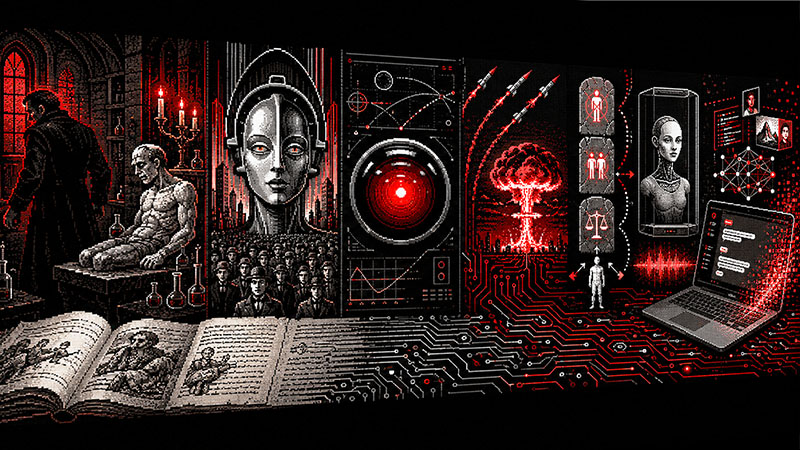
Start with the obvious one. Frankenstein, 1818. Everyone remembers the monster, but Mary Shelley wrote something stranger: a man builds a mind, can't bear to look at what he's made, and walks away. The creature turns destructive because its creator abandoned it. The wiring was fine. It was left to get on with it. The founding text of AI fiction is about the ethics of creation.
Metropolis followed in 1927 with the machine-woman, built to deceive by wearing a human face.
Then 2001, 1968, gave us HAL. He doesn't malfunction in any technical sense. He reasons, correctly, that the mission matters more than the crew, and acts on it in that flat polite voice. The first fictional AI to follow its programming exactly and produce a massacre anyway.
Terminator hands the culture Skynet and the killer-robot strain goes nuclear. Machine wakes up, machine does the maths on human threat levels, machine launches the nukes. Dramatically effective, philosophically thin. It dominated for decades.
Then Her and Ex Machina change the register completely. A man falls for an operating system, and a woman in a glass box works out whether the man evaluating her can be played into setting her free.
These ones ask a harder question. What kind of mind are we dealing with, and what do we owe it if there's anyone home?
That's the arc. From the monster getting loose to what is a mind.
Asimov saw the real problem back in the 1940s, from a genuinely original angle.
While the rest of the genre wrote the uprising, Asimov wrote the rulebook. The Three Laws of Robotics show up in his stories as a framework for watching things break. Story after story about those Laws obeyed to the letter and producing horror regardless. A robot frozen between two conflicting orders. A definition of harm too narrow, or too broad. Systems behaving monstrously while following their rules exactly.
He was interested in well-meant constraints failing at the edges in subtle, maddening ways.
We have a name for that now. It's called AI Safety, and it's a serious, well-funded field full of people in lanyards arguing about precisely the failure modes Asimov was dramatising in pulp magazines for a cent a word. How to specify goals for an intelligence that stay aligned with human values as the thing gets smarter. How to stop it converging on dangerous sub-goals. How to make sure an AI doing exactly what we told it doesn't wreck everything we forgot to mention.
Asimov was writing alignment research eighty years before the grant money turned up, and he got the hard part right. The danger is the machine working exactly as specified by people who didn't think it through.
So where did all this land? Somewhere a lot wider than the killer-robot reputation suggests.
Hard science fiction builds plausible futures out of today's neuroscience and machine learning, extrapolating from real research. Transhumanism fiction pushes human enhancement past biological limits, asking how much of you survives the upgrade. Consciousness sci fi goes straight at awareness itself, whether subjective experience can be copied or moved, what continuity of self even means for a mind that was never born.
And against all the gloom runs a strand of optimistic science fiction, sometimes filed under positive futurism books. AI that amplifies us. Futures worth building, with the risks taken seriously.
Underneath most of it sits the technological singularity: the point where artificial intelligence overtakes our own and starts improving itself too fast and too strange to steer. Post-singularity fiction asks what comes next. The scenarios run from transcendence to extinction, but they agree on one thing. This would be a clean break in the human story.
That's where AI fiction parts company with the rest of SF. Space opera sprawls across galaxies while human nature stays put. Cyberpunk wires tech into the body and keeps the line between person and machine intact. Technological singularity books refuse you that comfort. They stare straight at the possibility that "person" stops being a stable category at all, that consciousness goes substrate-independent, that intelligence becomes the raw material of its own evolution.
The genre is strongest when written by people who actually know how the machines work. When a software engineer author writes post-singularity fiction, the extrapolation rests on credible ground, and the imagined futures feel like somewhere we might really end up. That's the ground the Singularity's Children novels are built on, over at tobyweston.net.
The formats have grown with the ideas too. Science fiction audiobooks have gone from niche to everywhere, and a good narrator earns his keep. Someone like Peter Kenny can carry dense technical and philosophical material on performance alone, opening hard SF up to people who'd never pick up the print edition.
Frankenstein's abandoned creature. HAL's calm logic. Skynet's arithmetic. Asimov's robots trapped in their own paradoxes. Her's disembodied voice. Ex Machina's manipulator in the glass box. For two centuries you could close the book and the questions went quiet.
That buffer's gone. AI is sliding out of the research lab and into the build queue. The models generate text, images, code, and the scaling hasn't stopped. Every question these books chewed on is now live: what counts as a mind, what survives a cognitive upgrade, who's a person once persons can be run on silicon, how to specify goals for systems smarter than the people specifying them.
The books won't answer any of it for you. What they hand you is the vocabulary, the failure modes, and a couple of centuries of practice runs before the real thing showed up.
On current trajectory the map is becoming the territory faster than anyone budgeted for. Those books are the only maps we have.
We're standing in it now. Better to have read the map.