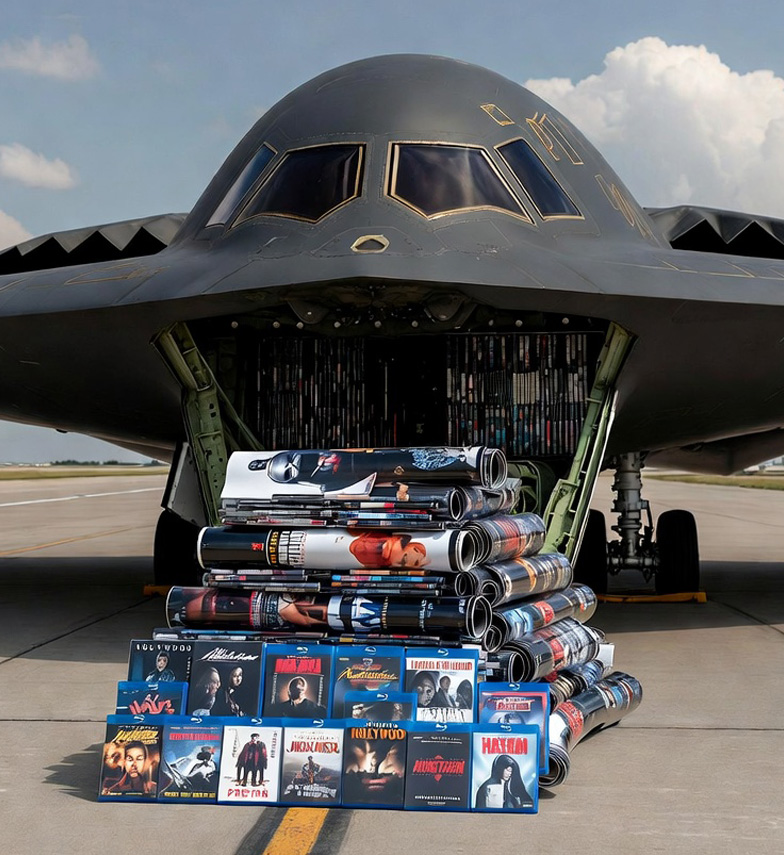
Loitering Munitions
Consider the ICBM:
An intercontinental ballistic missile isn't primarily a weapon, it's a delivery mechanism. The warhead does the killing; the missile is the elaborate, expensive infrastructure built to carry it to a target.
Everything else (the guidance systems, the fuel, the launch facilities, the supply chains) exists to solve one problem: getting the payload from here to there.
Hollywood movies work the same way. They're large, complex delivery mechanisms for memetic payloads. The film itself (the story, the production values, the performances) is infrastructure.
The payload is the ideological and cultural messaging baked in. Both ICBMs and Hollywood blockbusters represent massive accumulations of engineering, capital, and institutional knowledge built up over decades. Both are accretionary systems: layers of complexity bolted on incrementally, each solving problems created by previous layers.
Both share a critical vulnerability. Once an ICBM launches, its trajectory is fixed; once a film releases, its content is committed. If the target moves, the payload misses.
Enter the loitering munition.
Loitering munitions don't commit to a target immediately. They launch, patrol the battlespace, gather intelligence, and strike only when optimal conditions emerge. All the supply chain complexity (manufacturing, logistics, targeting systems) gets folded into a platform that delivers precision on demand.
The weapon becomes adaptive. It watches, waits, and chooses its moment.
Modern Hollywood has evolved the exact same capability.
Studios now routinely film multiple versions of key scenes. Structurally different versions: different dialogue, different framing, different character decisions, different ideological valence. These alternatives sit in the editing room, waiting.
Market testing reveals which demographic segments respond to which version. Cultural shifts signal which messages will land and which will backfire. Political winds flag which positions are safe and which are toxic.
Only then does the studio commit to a final cut.
The movie becomes adaptive. It doesn't deploy until conditions are optimal.
The practice is well-documented in industry reporting and filmmaker interviews. Endings change based on test screenings. Character arcs shift based on focus groups.
Dialogue gets rewritten and reshot weeks before release to align with current events. The theatrical cut differs from the streaming cut, which differs from the international cut, each optimised for different audiences and distribution windows.
What looks like standard business practice (testing, iteration, the usual) is a fundamental transformation in how cultural influence operates. The old model was pre-commitment: make the thing, release it, hope for the best. The new model is optionality: shoot everything, wait for the cultural terrain to reveal itself, then deploy the version most likely to land.
It's systemic. When you build industrial-scale infrastructure for cultural production while facing increasing pressure to minimise risk and maximise returns in a fragmented media landscape, the system selects for adaptability. Shooting multiple versions costs more upfront but dramatically reduces the risk of a costly misfire.
The studio that can pivot at the last moment has an advantage over the one locked into a single vision.
The parallel to military evolution is structural, the same underlying dynamic in both domains. When you've got expensive, complex delivery systems operating in uncertain environments, you face pressure to defer commitment as long as possible.
The ICBM gave way to loitering munitions for the same reason the traditional Hollywood film is giving way to multi-version production: the cost of being wrong is too high, and waiting costs less than missing.
The objection writes itself: "You're describing market responsiveness, not weapons." But that distinction assumes Hollywood's primary function is entertainment rather than influence.
Consider what movies actually do. They shape consensus about what's normal, what's possible, what's admirable, what's contemptible. They frame how we understand the world, making certain ideas feel natural and others alien.
That's memetic payload delivery, whether or not anyone involved thinks of it that way.
Movies have always carried ideological messages. What's changed is adaptability. A traditional film is an ICBM, launched with its message fixed, hoping conditions on impact match assumptions at launch; a multi-version film is a loitering munition, holding fire until the cultural terrain reveals which version will land hardest.
The infrastructure hasn't changed much. Cameras are better, effects more sophisticated, but the basic mechanics of production remain recognisable. The relationship between creation and deployment, though, has shifted completely: the gap between "film it" and "release it" is now a strategic window during which the payload gets selected based on real-time cultural intelligence.
This is mostly invisible to audiences because the final product still looks like a movie. You watch the version that deployed; you never see the alternatives that waited in reserve.
But the studios know. The editors know. The market researchers analysing focus group responses and social media sentiment know.
They've built a system that treats film as munitions requiring targeting data.
We're watching the same evolutionary pressure play out across domains. In warfare, precision and adaptability matter more than raw power. In cultural production, timing and targeting matter more than artistic vision.
Both evolved from large, pre-committed systems to adaptive, on-demand platforms. The weapon and the movie both got smarter: they wait to see where you are before they strike.