Science Fiction Needs to Dream Again
Science Fiction Needs to Dream Again
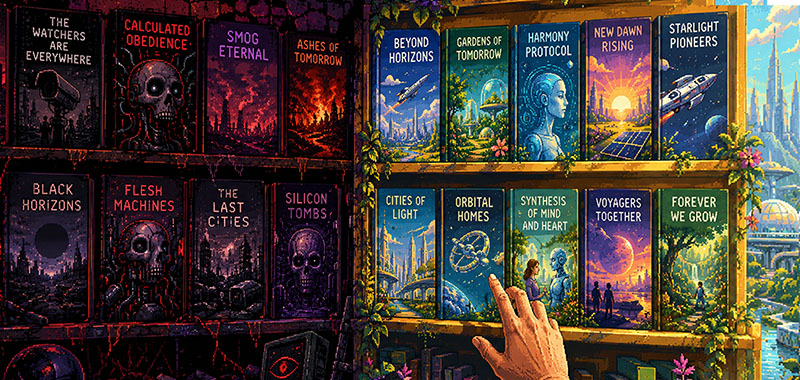
When did science fiction stop dreaming about better futures and start only warning about worse ones? Walk into any bookshop and the SF shelves sag with apocalypse and surveillance states, while stories about things getting better have grown rare enough to feel quaint.
This matters, because imagination sets the edges of what we think is possible. The stories we tell about the future shape the futures we're willing to build.
Utopian science fiction has quietly grown up. It started as static blueprints of perfect societies and turned into something far more useful: a genre about the messy business of things actually improving.
Early utopian fiction, from Thomas More onward, handed you a finished picture of the ideal society. Modern utopian science fiction works differently.
Star Trek's Federation still argues over the Prime Directive: when standing back to let a civilisation die is principle, and when it's cowardice in a nicer uniform. Iain M. Banks' Culture novels give us a post-scarcity civilisation that argues, at length, about the ethics of meddling with less advanced ones.
These are stories about how a society keeps its footing through technological upheaval and political conflict, while staying committed to people flourishing.
The focus moved from destination to journey.
This shift earns its keep when you point it at artificial intelligence. Dystopian AI stories frame the whole thing as zero-sum: human intelligence versus machine intelligence, ending in replacement or a boot on the neck. Utopian post-singularity fiction asks better questions.
Writers like Banks show worlds where AI and humans live in each other's pockets to mutual benefit. His Minds, ship-scale AIs with more wit and warmth than the humans they look after, run the whole civilisation and leave people free to get on with being gloriously pointless.
These stories don't wave away the genuine dangers of advanced AI. They imagine how those dangers get met, and lived with.
Post-singularity fiction gets to treat technology as something that deepens human capability and meaning. It's the ground my own Singularity's Children novels work: uploaded minds spread across multiple bodies, haggling over what's left of being human.
The genre pulls in writers with day jobs in engineering, people who bring real technical scepticism to imagining how AI and consciousness uploading might make a life better. That grounds the optimism in plausible mechanism, in engineering you could almost sketch, so the good future stops reading as a wish and starts reading as a spec. What you get is fiction that stretches the range of futures you can even picture.
The usual charge is naive escapism. It misses. Optimism doesn't buy you a conflict-free story.
The Culture argues endlessly about when to intervene. Post-singularity stories chew on identity and meaning in a world where scarcity's been solved. When you can fork yourself, back yourself up and wake up in six bodies at once, "who am I" stops being a stoner question and turns into an admin one.
Better problems than poverty and famine, sure. Still problems.
This does something practical. Dystopias warn you off what to avoid. But knowing what to dodge tells you nothing about where to aim.
Utopian science fiction supplies the other half: a picture of somewhere you might actually want to end up. In a decade of AI anxiety and climate dread, it's a reminder that technology's path isn't fixed in advance. The future we get depends on choices we're making right now.
We're already fluent in how it all goes wrong. We've got whole shelves of it, and Netflix besides.
Dreaming the good future, detailed enough that someone could aim at it, is the harder job. It's also the one that counts.
So somebody had better get on with writing it.