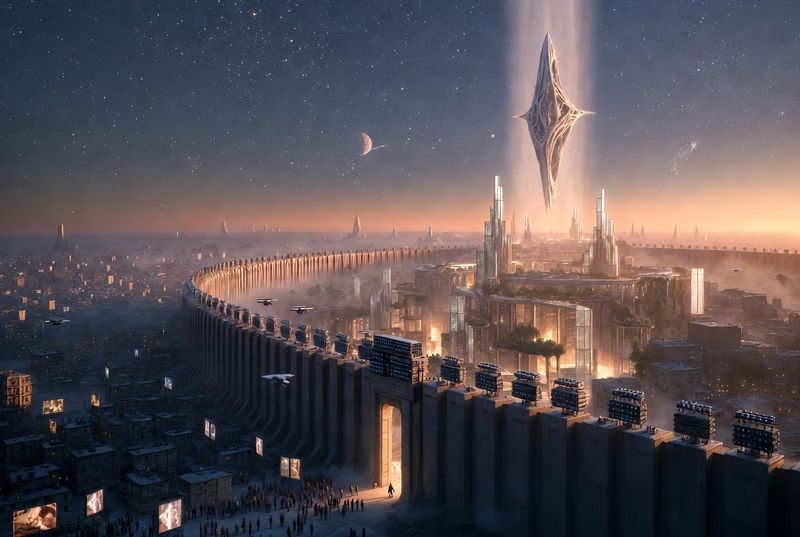
The Citadels and the Stars
Things usually turn out alright in the end. That sounds glib and obviously it doesn’t mean there aren’t troubling intermediate periods where things get a bit crunchy, but it’s actually pretty accurate if you take the long view.
New technologies tend to create new fears before they deliver quality of life improvements. We’re wired to consider worst case scenarios. It’s easy to see how a new technology will negatively impact the current situation, because in that thought experiment both the technology and the current situation are known quantities. Imagining the upside is harder, because the future that makes use of the technology doesn’t exist yet and still needs to be invented. All the positive changes are still hidden behind sparks of inspiration from genius entrepreneurs that haven’t struck yet, and for us, whether normie or scifi author, it’s tricky to predict all of that upside.
So at the moment we’re worrying that AI is going to take all our jobs, and we don’t have any particularly good solutions beyond universal basic income or some flavour of centralised state welfare.
But desk jobs like most of us have today are less than a hundred years old.
The corporation separates the workers from the products of their toil. I’m not a communist—this structure has somehow managed to unlock massive amounts of wealth while also decoupling an individual’s work from their rewards. If you’re working your own field (an actual field with soil and weeds) the fruits of your labour go to you. If you’re working for a corporation, the fruits of your labour go to the shareholders. The corporation pays only as much as game theory requires to keep you at your desk. The bureaucracy brings politics, factionalism and lag—terrible mind crushing lag. The kind of decision-maker you need when things are changing is radically different from the kind you need in a steady state, and switching between the two usually requires the aging gentlemen at the top to accept it’s time to retire, which can deliver multi-decade lead times.
None of this is a judgement. It’s just worth noting that the way things are today isn’t the way things always were.
So. AI takes all the jobs. Nobody has an office to go to... oh no, oh my, what are we all going to do?
Chill.
Mankind is a million year’s old: bullshit-jobs only a century. We’ll manage.
People are going to go back to growing and making what they need—except now the growing will be done with synthetic biology fermentation and the making by 3D printers. Small holdings will ultimately be measured by the amount of incident solar radiation they can pull in, because solar radiation is the energy input behind everything else: food, computation, manufacturing, wealth.
Soon you’re making food with algae and printing your shoes. In a couple of decades, the algae is producing medicine too. Trees in the garden are fruiting with longevity treatments, and your 3D printer is turning out teeth, glasses and prosthetics; another half century and it’s printing steaks and fish fillets, then kidneys and beating hearts...
As the technology improves, the available options for a properly off-grid life climb—all the way to a not-too-distant future, when you’ll be assembling a spaceship in your back garden and flying off to claim your first asteroid.
Of course, many people won’t take this path. They’ll stay as employees or dependants of an existing system already in slow collapse. While the new system grows, the old is going to be predominantly concerned with keeping its cattle from stampeding. It’ll confiscate whatever wealth it can get its hands on. It’ll introduce increasingly draconian measures to pacify the population. It’ll incite violence to justify crackdowns that were already coming anyway. It’ll penalise the productive to bribe the less productive not to riot. It will become progressively and inevitably more unproductive while it watches people try to leave—tries to prevent them from leaving, closes the loopholes, and wonders why it can’t produce anything any more...
At some point the Gov will realise they need productive people doing actual cool stuff and that the way they’re set up makes this basically impossible. So: perestroika. Shenzhen. Free enterprise zones with big fences and private security, running on Bitcoin or gold or whatever internationally recognised store of value survives the slop coin era—because everyone outside the fence will be paid in SlopCoin, the government-issued digital currency that evaporates on a timer and evaporates if you slip up and say the wrong thing.
Of course, most people will profess to hate the Citadels—until they’re allowed in. Day-workers will pass through as transients, squirrelling away hard currency so that they might eventually escape the permanent under class and purchase citizenship at one of the startup lower-tier network city-states.
The cannibalistic government will need the Citadels to produce the things it’s no longer capable of making, so it’ll grant them concessions.
Citadels are freedom, reluctantly granted.
But, the third way, avoiding the slop, never being tempted by the Citadels, will be distributed individual production. You can regulate a factory. Good luck regulating a million gardens fermenting their own food and medicine, or a million workshops printing their own goods, germs and guns.
To those who opt out—who secure their own slice of incident solar radiation and compound it into information and artefacts—your challenge will be keeping your head down through the authoritarian years, because the system’s last gasps are its most dangerous.
Keep your spaceship buried, until you can fly it to eternity.