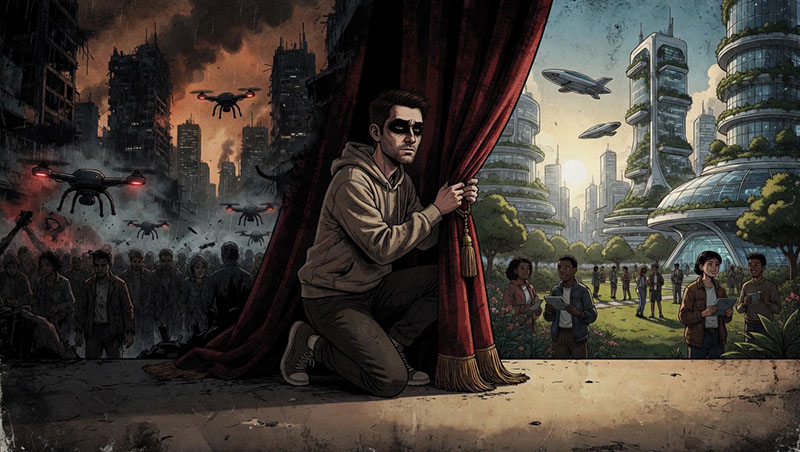
Positive Futurism Books for Readers Who Want More Than Dystopia
Positive Futurism Books for Readers Who Want More Than Dystopia
If you spend any time browsing science fiction shelves, you could be forgiven for thinking the future has already been lost. The dominant mood is collapse: authoritarian states, broken ecologies, runaway AI, and ordinary people reduced to collateral damage inside systems too large to resist. There is a place for those stories. But there is also a growing hunger for something else.
Readers searching for positive futurism books are often not looking for fluff. They are looking for fiction that takes technology, systems, and human conflict seriously without insisting that every future must end in spiritual or civilisational ruin. They want ambition without naivety. Hope without sentimentality.
What the market currently rewards
A quick look at the broader field shows the pattern. Greg Egan is admired for conceptual rigour and mathematical audacity. Peter Watts leans into high-stakes biological and cognitive pressure, often with a much darker emotional register. Search results around futurism books are also crowded with broad recommendation lists rather than author-specific pages that speak directly to readers who want technologically literate but ultimately constructive futures.
That leaves an opening. There is demand for books that engage with AI, post-humanity, and social transformation while preserving the possibility that people might build something better than a prettier catastrophe.
What makes positive futurism books worth reading
The phrase can sound soft if you have mostly encountered it second-hand. In practice, the best positive futurism books are demanding. They still need tension, sacrifice, competing values and unintended consequences. The difference is that they do not confuse seriousness with despair.
A convincing positive future has to work harder than a dystopian one. You cannot simply break a system and let menace do the rest. You have to imagine institutions, technologies and cultures that remain recognisably human while changing the conditions of life. You have to ask harder questions: if scarcity eases, what replaces status anxiety? If AI becomes useful rather than monstrous, what happens to identity, responsibility and purpose? If civilisation survives, what new conflicts emerge once survival is no longer the only game in town?
Why this matters for AI-driven science fiction
That is exactly where Toby Weston's work sits. Across the books page, the Singularity's Children series treats AI, propaganda, social breakdown and post-human transition as real pressures, not decorative wallpaper. But the series is equally interested in what survives those pressures: loyalty, humour, ingenuity, love, and the possibility that humanity might mature rather than simply implode.
This is also what distinguishes positive futurism from bland futurist branding. The future is not positive because everyone agrees, or because technology solves the human condition. It is positive because the long arc still bends toward greater possibility. There are still factions, failures, opportunists and blind spots. The point is not that the road is smooth. The point is that it leads somewhere worth going.
Positive futurism books still need danger
One reason readers bounce off explicitly hopeful fiction is that some books try to remove friction altogether. But drama needs resistance. The strongest positive futurism books understand that optimism is not the absence of conflict; it is conflict under conditions where progress remains imaginable.
That is why the most compelling stories in this space often begin amid breakdown. Weston's fiction starts close enough to our own world to feel uncomfortable: elite capture, automated persuasion, political exhaustion and deep technological inequality. From there, the novels widen into something stranger and more ambitious. If you want a sense of the philosophy behind that move, the site essay Why Optimistic Science Fiction Is Harder Than It Looks makes the case clearly. Hope is not easier to write than collapse. It is harder because it has to be earned.
Where to start if this is your lane
If you are specifically looking for positive futurism books that engage with AI and consciousness rather than avoiding them, start with the Toby Weston catalogue. The series is built for readers who enjoy large-scale speculative change but do not want every book to end by confirming that intelligence, technology and civilisation were mistakes. If you prefer listening, the audiobooks are also highlighted there, with Peter Kenny bringing the world to life.
If you want to explore the ideas before committing to a series, the blog gives a good sense of the wider concerns: technology, storytelling, consciousness, futurism and the long argument between cynicism and possibility. The recent piece on why science fiction audiobooks hit different is also a useful bridge for readers who discover fiction through audio first.
Positive futurism is sometimes treated as a niche mood or a marketing label. I think it is better understood as a challenge. Can a writer imagine a future transformed by intelligence, automation and post-human possibility without becoming either preachy or apocalyptic? Can the story remain honest about power while still allowing for growth?
The best positive futurism books answer yes. They do not deny darkness. They refuse to stop there. For readers who want science fiction that takes AI seriously, keeps its systems coherent, and still leaves room for hope, that is not a minor distinction. It is the whole point.
Marai