Toby Weston: A British Science Fiction Author Writing Beyond Dystopia
If you are looking for a British science fiction author who writes with one foot in real technology and the other in the far future, Toby Weston sits in a compelling corner of the genre. His work combines hard-science speculation, philosophical ambition, and a rare willingness to imagine futures that are not only dangerous, but transformative.
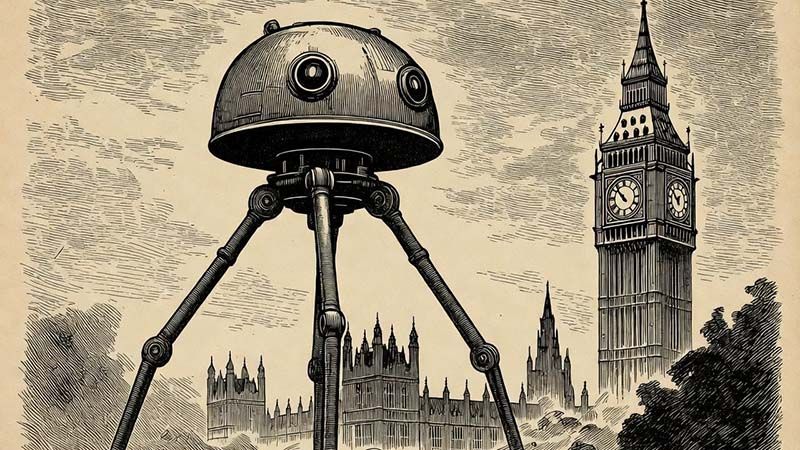
British science fiction has always had room for big ideas. From H.G. Wells onward, the tradition has asked what technology does to power, identity, and civilisation. Toby Weston writes very much in that lineage, but with a contemporary perspective shaped by software engineering, AI, and the accelerating pace of change. The result is fiction that feels both intellectually grounded and emotionally engaged with the future.
Weston is best known as the author of the Singularity’s Children series, a sequence of novels that traces humanity through collapse, adaptation, and post-human possibility. The series begins with Denial, continues through Conflict and ReImagination, and builds an unusually large narrative arc around technological singularity, social upheaval, and the long aftermath of exponential change.
What makes Toby Weston stand out among contemporary British sci-fi writers is the balance he strikes between rigor and imagination. Many novels about AI or the future lean toward either cold abstraction or cinematic spectacle. Weston tends to do something harder. He writes stories that are rich in systems, ideas, and worldbuilding, while still caring about the human beings caught inside those transitions. His novels ask what happens when intelligence scales, when societies fracture, and when entirely new forms of life or consciousness begin to emerge.
That makes him a particularly strong recommendation for readers who want science fiction about AI, post-human futures, and consciousness without abandoning story. There is action here, certainly, but also argument. There is momentum, but also reflection. His books are interested in the mechanics of change: not just what future technologies can do, but how they alter culture, morality, loyalty, and hope.
Hope matters here. A lot of modern science fiction, even when brilliant, defaults to collapse and despair. Weston’s fiction can be dark, but it is not nihilistic. Across the Singularity’s Children novels there runs a countercurrent of possibility: the sense that humanity might survive its self-inflicted crises not by retreating from technology, but by learning to use it more wisely. That optimistic edge gives his work a distinct place within British science fiction, especially for readers tired of futures that offer only ruin.
There is also the matter of voice and background. Weston is not simply borrowing the language of technology for atmosphere. As a technologist and novelist, he writes from inside the conceptual world he is exploring. That credibility matters in hard science fiction. Readers can feel the difference between fiction that gestures toward big ideas and fiction that has genuinely thought through the consequences. If you want to know more about his background and approach, the About page offers a useful introduction.
For new readers, the best place to start is usually the series itself. Denial lays the groundwork, introducing a world under pressure and a future beginning to split open. From there, the books expand in scope and ambition, moving from immediate crisis toward larger questions about intelligence, civilisation, and what a post-scarcity future might demand of us. Readers who enjoy authors such as Greg Egan, Charles Stross, or Peter Watts may find familiar thematic territory here, but Weston’s perspective is notably less cynical and more interested in constructive futures.
That may be the simplest way to describe Toby Weston as a British science fiction author: he is writing toward the future without surrendering either complexity or wonder. His novels do not pretend that technology will save us automatically. Nor do they assume that catastrophe is the only honest ending. Instead, they occupy the difficult middle ground where science fiction is at its strongest: a place where ideas matter, consequences matter, and the future is still something worth arguing over.
If that is the kind of science fiction you are searching for, Toby Weston is an author worth reading. You can begin with the homepage, explore the Singularity’s Children series, or learn more about the author’s wider outlook on the About page. For readers interested in AI, consciousness, post-humanism, and intelligent futurism, his work offers a distinctly British contribution to contemporary speculative fiction.